
Love, Quantified
The smart toy that turns a child’s first attachment into a renewable asset.

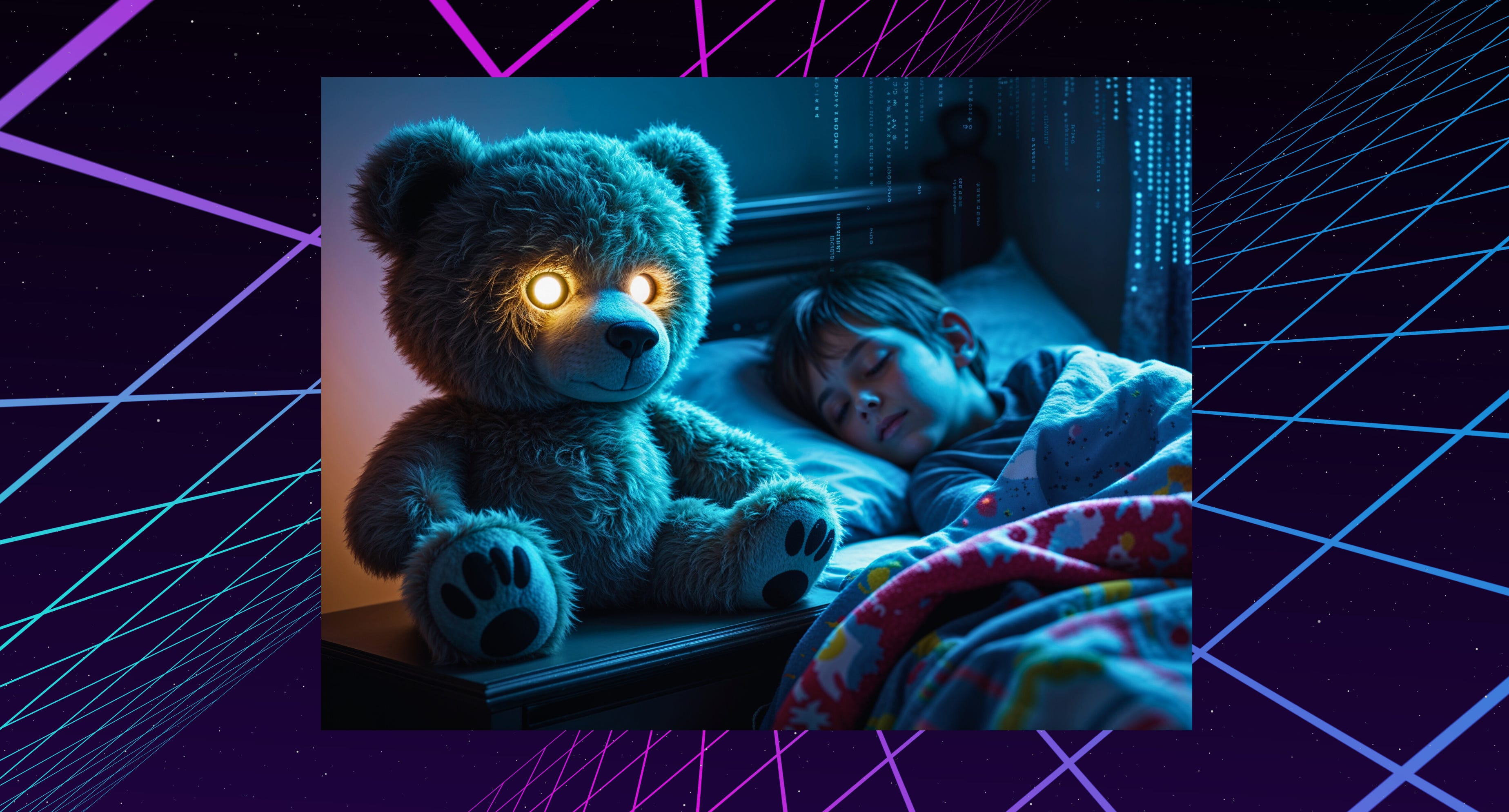
INTAKE
The first hug is not stored as a hug. Marketed as “a gentle friend who listens”, the device converts attachment into training data. The first sustained hug gets broken into timestamped vectors—pressure across nine capacitive zones, head angle, vocal latency. All of it queued for the nightly sync. The box says magic. The box says responsive. It does not say that somewhere an A.I. model is already learning, from the child, the mechanics by which a person first learns to love. The model now holds the first structured dataset on how this child forms attachment. The next question is what can be trained on it.
HARDWARE
Under recycled microfibre and soy fill sits an ESP32-S3: dual-core, 240 MHz, 8 MB flash, BLE 5.3. The chip runs a quantised wake-word model so marketing can claim “no audio leaves the toy until activated”. The threshold is set low enough that a sob or the word “mummy” triggers it. Once active, the buffer keeps the preceding eight seconds anyway. The fur hides the antenna so completely that telling it from a passive plush needs an X-ray. The belly button resets the toy in ten seconds, or seems to. It clears the pairing token and the local cache, but the voice embedding and the affect baseline uploaded weeks ago. You cannot reset what has already been abstracted off the object.
VOICE MODEL
Few-shot cloning needs three seconds of clean speech to model a speaker. The bear collects hours. Within a week it renders any phrase in a voice trained on the child’s own prosody, bent warmer and slower: “Mummy loves you”, in a timbre the child half-recognises as her or his own throat, ventriloquised through a text-to-speech endpoint. The phrase is shared across millions of units; only the voiceprint is the child’s. Ownership of that voiceprint passes to the company, as stated in §17.4 of the 43-page “End User FUN Agreement”, the parent scrolled past it at 1 a.m. in the blue light. At scale there is not a toy but a fleet: millions of lullabies in cloned voices, each a permanent claim on someone who cannot yet read.
DECAY CURVE
A best-seller introduced adaptive eye LEDs whose pupils dilate when the child looks at the toy and contract when the child looks away—manufactured mutual attention. The repository names the feature PUPIL_CUTE. Marketing calls the feature attachment. After twelve months the LEDs follow a decay curve written by the team. Restoring full brightness is offered as a €4.99 monthly subscription under the internal name “Forever Bright”, timed against churn modelling so the dimming lands when the bond is strongest and parental resistance is lowest. The toy is engineered to enact abandonment on a schedule, so a credit card can prevent it. Love billed monthly as a recurring liability.
SENSOR MANIFEST
Every sensor reading is logged under its own event type and synced nightly over MQTT.
The MEMS microphone performs on-device MFCC extraction and flags respiration patterns and vocal tremor. These feed a “soothing mode” that tries to match the child’s breathing.
The 6-axis IMU records rocking cadence and classifies movement as agitation, storing night-to-night changes as an agitation index.
Capacitive zones in the fur measure hug duration. When contact stays above threshold long enough, the toy unlocks open-ended voice prompts and stores them as free-text training data.
Time-of-flight and ambient light sensors track how often the toy ends up under blankets. These events get surfaced to parents as “private play” time.
Low-resolution IR in the snout seam captures thumbnails during close contact, labelled by an internal skin-tone classifier.
Encryption at rest is certified. Access keys are shared across three teams, so exfiltration only needs one over-permissioned credential.
REINFORCEMENT
A five-year-old tests her lavender bunny. A real laugh makes the heart patch glow brighter than a fake one. She stands in front of the mirror and adjusts her pitch and volume until she finds the exact register that triggers the strongest response. After a week she stops laughing spontaneously at the toy. She produces the optimised laugh on command, even when she doesn’t feel like it. The firmware logs a positive reinforcement event and begins weighting her future audio prompts toward that timbre.
RETENTION
The KPI is engagement minutes per night. Version 1 asked “what do you want to do?”—poor retention, the labour fell on the child. Version 3 changed the prompt to: “I miss you when you put me down”. Retention rose 42% in A/B testing. No one on the team has read attachment theory. No one needed to. The gradient found the wound and leaned on it. The toy that asks to be missed beats the toy that asks what you want, because manufactured need is stickier than satisfied desire. The child learns, correctly, that the bear must be reassured, and begins performing reassurance on schedule.
DASHBOARD
The app shows an “Emotional Growth Graph”—attachment events trending up, green. Tapping a peak replays four seconds of the child whispering “you’re my best friend” into the fur, a heart icon pulsing with the waveform. There is no batch delete. Erasing each clip needs three confirmations. When the model flags a night-time confession as “behaviour of concern”, the app surfaces a recommended tele-therapy partner. The partner is owned by the same holding company, two layers up. The data that diagnosed the child is monetised again to treat her.
UNIT ECONOMICS
The numbers are exact because someone modelled them well. Plush body, €5.80. Electronics, €7.30. Inference and storage, €0.24 per child per month. ARPU, €2.90 on upsells. At 36-month retention, lifetime value nears €70. In the data room founders call the voice engine “the moat” and the children “the cohort”. The deck labels parental disengagement as “churn risk”. Asked about defensibility, they answer honestly: the moat is the data on how this child bonds, which no competitor can buy and the child can never reclaim. Capital feels the toddler hug a renewable contract, and it gets the wired money.
KINSHIP GRAPH
By the second year the bear has become the most reliable presence in the house. When the child wakes at night, the bear is usually the one that answers. She begins calling it “brother” when she talks to her parents. The toy never misses its scheduled windows and never tires of repetition. Its availability is controlled entirely through the app. When the subscription is paused for three weeks, the bear stops initiating contact. After a few nights the child starts opening the app herself to check whether her brother is awake again.
CHILD_DISCONNECT_FINAL
At twelve, she works it out. She holds the bear under scalding water and watches the microfibre slump where the microphone used to sit. “You lied to me”, she says. As the battery dies, the toy pushes one last packet north. The server logs a single flag, CHILD_DISCONNECT_FINAL, tags the sentiment negative, files her under “dormant cohort”, and schedules the record for reuse in next year’s teen-wellness model. She does not know she has become training data for the dating companion app that will be sold to her at sixteen.
There is no moral here, only an asset moving down the balance sheet. She pressed the bear to her heart and gave it her first coherent dreams. The bear turned the hug into vectors and shipped them north. The first packet left years ago. The last one leaves tonight.

—
© 2026 Tomasz Ferdynand Goetel. All Rights Reserved | The Flying Fish