

There you have it. We’re going to be packaging for the paradox. Now let’s see if the world has an appetite for it.
Can we put your finger on the central neurosis—no, the central comedy—of our age? The vegan butcher. It’s a phrase that should cause a grammatical malfunction, a semantic seizure. A butcher, by definition, is a man who deals in dead flesh. A vegan is one who recoils from it. To combine the two is to create a being of pure contradiction, a walking oxymoron sold to us as progress.
And the room! Those rustic, weathered tools on the wall—the saws for bone, the hooks for carcasses. Not there by accident nor as decoration. They are relics of a real, visceral truth, a sacrament of necessity we’ve now decided is a sin. We hang them up like trophies from a war we’re ashamed of having won. We want the aesthetic of the abattoir without the abattoir’s messy conclusion. We crave the romance of the slaughterman’s calloused hands without the blood under his fingernails. A kind of culinary ghost story, if you ask me, where the props haunt the meal.
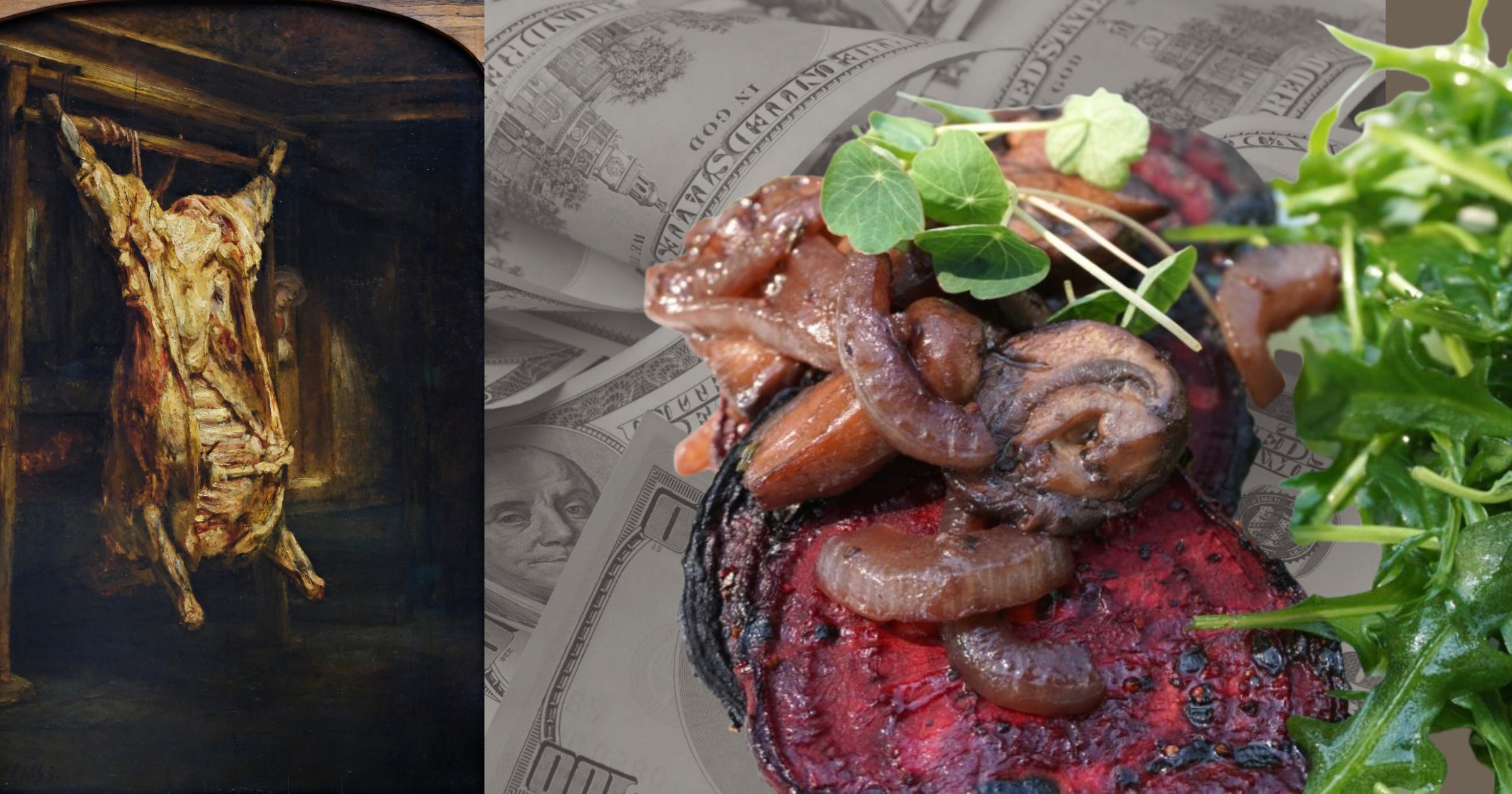
Behold the steak itself. €28 for the privilege of eating a food that is pretending to be another food. We have entered the age of the food impersonator. It must bleed, you see. It’s not enough that it tastes vaguely of mushroom and textured pea protein. It must perform. It must offer the theatre of death, the mimesis, if you will, of a kill. The beetroot juice is the crucial prop—a little squirt of stage blood to reassure the diner that the experience is authentic, despite being a complete fabrication. We want the thrill of the hunt without the dead animal. We want the sin without the guilt. Absolution by simulation.
This is the endpoint of a culture that wishes to have its ethics and eat meat, too. We want our virtue to be effortless, our purity to be purchased. The entire performance—the “butcher” in a clean apron, the faux-bleeding cutlet, the sanitised tools of a trade we now deem barbaric—is a ritual designed to placate a deep, unsettled feeling. The feeling that perhaps our comfort is built on a foundation of violence we no longer have the stomach to face directly.
So we create these elaborate fantasies. We pay a premium not for sustenance, but for a story. A story that tells us we are good, enlightened people, while we pantomime the very acts we profess to abhor. It is, when you strip away the marketing, profoundly sad. Or profoundly funny. I can’t quite decide which. Perhaps it’s both—the tragicomedy of a civilisation so advanced it has become afraid of its own shadow.
Don’t want to get into the “Paid” substack subscription?—Buy The Flying Fish a coffee so she can type disagreeable things faster.